









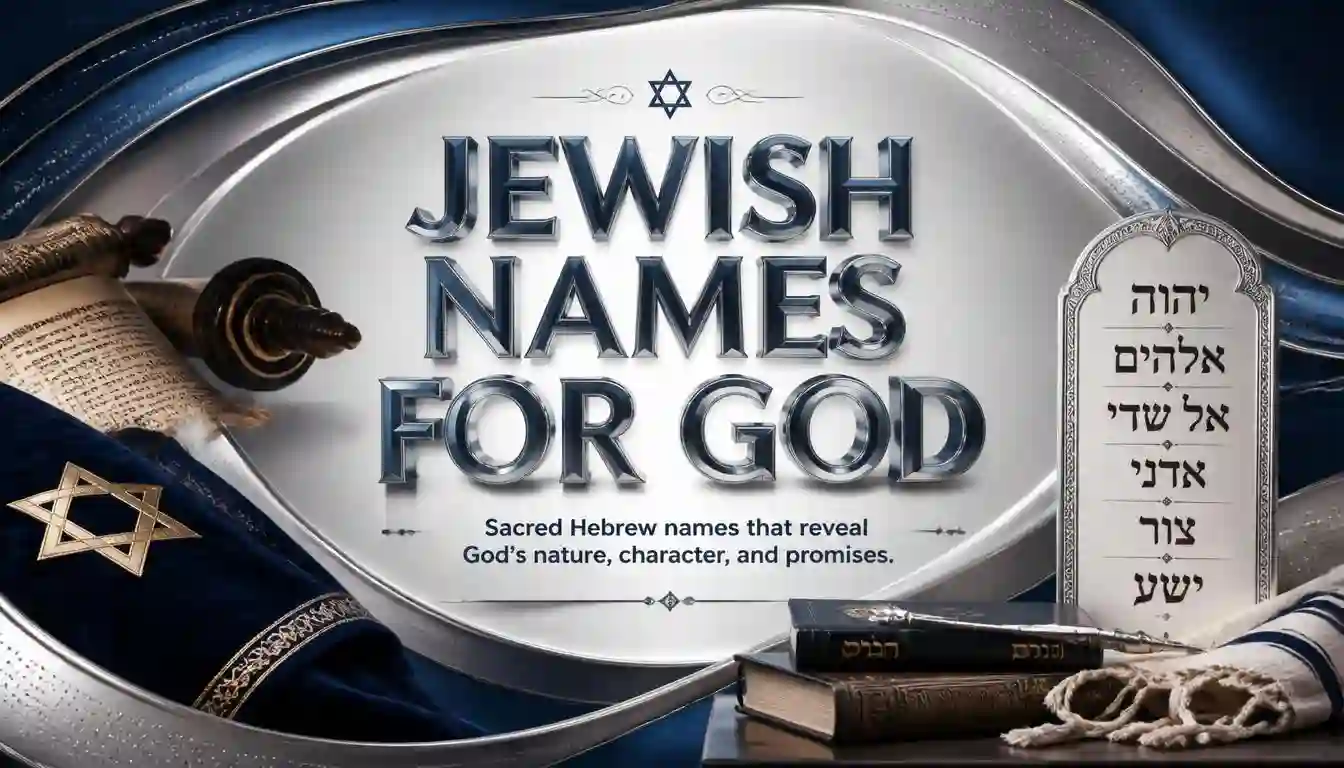
Jewish tradition uses several sacred names and titles for God, each offering a different way to express divine greatness, holiness, power, mercy, and presence.Many of these names appear in the Hebrew Bible, while Jewish people use others in prayers, teachings, and everyday conversations.
Learning the Jewish names for God can help readers understand biblical passages, Hebrew words, and the spiritual traditions of Judaism. Some names describe God as the Creator or Almighty, while others emphasize God’s eternal nature or relationship with humanity.
This guide explores important Hebrew names for God, their meanings, biblical connections, and the traditions surrounding their use.
What Are the Jewish Names for God?
The Jewish names for God include Hebrew names found in the Torah and other biblical writings, as well as titles and expressions used in Jewish religious life. These names do not refer to different gods. Rather, they express different aspects of the one God in Jewish monotheistic belief.
Some names are used in prayer, some appear in biblical texts, and others are preferred in ordinary conversation out of reverence.
For example, Elohim is a Hebrew word for God, Adonai means Lord or Master, and Hashem means “the Name.” The four-letter Hebrew name YHWH holds special holiness in Jewish tradition, so Jewish people traditionally avoid pronouncing it aloud. My Jewish Learning explains these distinctions in its introduction to the names of God.
The Most Important Hebrew Names for God
The following names and titles are among the best-known in Jewish tradition.
1. YHWH (יהוה) — The Four-Letter Divine Name
YHWH, also written YHVH, is the distinctive four-letter name of God in the Hebrew Bible. It is known as the Tetragrammaton, a term referring to its four Hebrew letters: Yod, Heh, Vav, and Heh.
Its original pronunciation is uncertain. Some scholars reconstruct it as Yahweh, but Jewish tradition generally avoids pronouncing this name aloud.
During traditional Torah readings and prayers, Jewish people commonly say Adonai instead of YHWH. Many English Bible translations use LORD in capital letters to represent this name.
Why it matters: YHWH is central to understanding how the Hebrew Bible identifies God and how Jewish tradition approaches the holiness of divine names.
2. Adonai (אֲדֹנָי) — Lord or Master
Adonai means “Lord” and can also mean “my Lord” or “my Master.”
Jewish people traditionally say Adonai during prayers and public readings of biblical passages that contain YHWH.. The word expresses reverence and acknowledges God’s authority.
Meaning: Lord, Master.
Common context: Jewish prayer, synagogue services, and Torah reading.
3. Elohim (אֱלֹהִים) — God
Elohim is one of the most frequently encountered Hebrew words for God in the Hebrew Bible. It appears in the opening verse of Genesis, where God creates the heavens and the earth.
Although Elohim has a grammatically plural form, it is commonly used with singular verbs when referring to the God of Israel.
The word can also refer to other gods or divine beings in certain biblical contexts, so its meaning depends on the passage.
Meaning: God; in some contexts, gods or divine beings.
Common context: Biblical descriptions of God’s creative power, authority, and relationship with the world.
4. El (אֵל) — God
El is a short, ancient Semitic word meaning “God” or “deity.” It appears in the Hebrew Bible both independently and as part of longer expressions.
It is also found in many Hebrew personal names, including names such as Michael and Daniel.
Meaning: God or Mighty One.
Common context: Biblical poetry, divine titles, and Hebrew personal names.
5. El Shaddai (אֵל שַׁדַּי) — God Almighty
Jewish tradition translates El Shaddai as “God Almighty,” although scholars continue to debate the origin and exact meaning of Shaddai.
The title appears in Genesis, including passages associated with God’s covenant with Abraham.
Meaning: Traditionally, God Almighty.
Common context: Biblical passages emphasizing divine power, covenant, and blessing.
6. El Elyon (אֵל עֶלְיוֹן) — God Most High
El Elyon means “God Most High.” The Hebrew word elyon conveys the idea of being high or exalted.
This title appears in Genesis 14 in connection with Melchizedek, who refers to God as God Most High.
Meaning: God Most High.
Common context: Biblical passages emphasizing God’s supremacy and exalted position.
7. El Olam (אֵל עוֹלָם) — Everlasting God
El Olam is commonly translated as “Everlasting God” or “Eternal God.”
The expression appears in Genesis 21:33, where Abraham calls upon the name of the Lord, the Everlasting God.
Meaning: Everlasting or Eternal God.
Common context: Reflections on God’s enduring nature and eternity.
8. Ehyeh Asher Ehyeh (אֶהְיֶה אֲשֶׁר אֶהְיֶה) — I Am That I Am
This expression appears in Exodus 3:14, when God speaks to Moses from the burning bush.
Translators often render it as “I Am That I Am,” although some prefer “I Will Be What I Will Be” because the Hebrew verb can express a future meaning.
The expression is closely associated with God’s revelation to Moses and the following account of the divine name.
Meaning: Commonly translated as “I Am That I Am.”
Common context: Exodus, divine revelation, and discussions of God’s existence and presence.
9. Tzevaot (צְבָאוֹת) — Hosts or Armies
Tzevaot means “hosts” or “armies.” When used in a divine title, it conveys the idea of the Lord of Hosts.
The expression appears in biblical passages and Jewish prayers. Its precise emphasis depends on the context, including imagery of heavenly hosts or divine sovereignty.
Meaning: Hosts, armies, or multitudes.
Common context: Biblical poetry, prophetic writings, and liturgical expressions.
10. Shaddai (שַׁדַּי) — Almighty
Shaddai is a divine name that also appears independently of the compound title El Shaddai.
It is traditionally associated with divine might, although scholars debate its original etymology. The word appears in several biblical passages, including the Book of Job.
Meaning: Traditionally associated with the Almighty.
Common context: Biblical poetry, blessings, and references to divine power.
Jewish Names for God and Their Meanings
Here is a quick-reference table of important names and titles.
| Hebrew name or title | Common English meaning |
| YHWH / YHVH | The four-letter divine name |
| Adonai | Lord or Master |
| Elohim | God |
| El | God or Mighty One |
| El Shaddai | God Almighty |
| El Elyon | God Most High |
| El Olam | Everlasting God |
| Ehyeh Asher Ehyeh | I Am That I Am |
| Tzevaot | Hosts or armies |
| Shaddai | Traditionally, Almighty |
| Hashem | The Name |
| HaMakom | The Place; a traditional divine title |
| HaKadosh Baruch Hu | The Holy One, Blessed Be He |
Translations are approximate, and not every expression in this table has the same religious or legal status. The table includes both biblical divine names and titles used in later Jewish tradition.
Descriptive Titles and Expressions Used for God
Not every expression used for God is a personal name. Some are titles, descriptions, or respectful ways of referring to the divine.
Hashem (הַשֵּׁם) — The Name
Hashem literally means “the Name.” It is widely used in everyday Jewish speech as a respectful reference to God.
Rather than saying a sacred biblical name in ordinary conversation, many Jews use Hashem as a customary alternative.
HaMakom (הַמָּקוֹם) — The Place
HaMakom literally means “the Place” and is used as a traditional title for God.
It appears in Jewish literature and expressions, including the Passover Haggadah. The title is not simply a reference to a physical location; it has a broader religious significance.
HaKadosh Baruch Hu — The Holy One, Blessed Be He
This Hebrew expression means “the Holy One, Blessed Be He.” It is a familiar title in rabbinic literature and Jewish religious discussion.
It emphasizes God’s holiness and is often used when discussing biblical narratives, religious teachings, and Jewish law.
Rachum ve-Chanun — Merciful and Gracious
These Hebrew words describe God as merciful and gracious. They are attributes rather than a single personal name.
Related descriptions appear in Exodus 34:6, a passage important in Jewish tradition for its presentation of divine compassion and mercy.
Why Do Jewish People Avoid Pronouncing God’s Holiest Name?
Jewish tradition treats the four-letter name YHWH with special reverence. Jewish people traditionally avoid pronouncing it aloud because they consider the name holy and seek to honor the commandment against taking God’s name in vain.
Historically, the name had a special role in Temple worship. In later Jewish practice, Adonai became the customary spoken substitute in prayer and Torah reading.
Hashem is commonly used outside formal prayer, particularly in everyday conversation.
Writing customs also differ. Some Jewish communities, especially traditional and Orthodox communities, write “G-d” in English as an expression of reverence. Other Jewish communities do not consider this spelling necessary. These practices should not be assumed to be universal among all Jews
Are All Names of God Considered Equally Sacred?
No. Jewish tradition distinguishes between particular sacred names, descriptive titles, and ordinary words used to speak about God.
Classical Jewish legal discussions identify a group of especially sacred divine names. The exact classification and treatment of particular terms depend on the relevant religious sources and legal interpretations.
The four-letter name YHWH receives especially careful treatment. Adonai, Elohim, El, and Shaddai are also important in discussions of sacred names. Other expressions, such as Hashem, are used as respectful alternatives in ordinary speech.
Writing, erasing, disposing of, and pronouncing divine names can involve different considerations. Jewish practice varies by community and circumstance, so a simple list should not be treated as a complete ruling on religious law.
How to Understand God’s Names in the Hebrew Bible
The best way to understand a divine name is to read it in its original context instead of relying on a one-word English translation.
- Read the surrounding passage. A name may appear in a story about creation, a covenant, a prayer, or a prophetic message.
- Check the Hebrew wording. Transliteration can vary, and one English spelling may represent different Hebrew forms.
- Distinguish names from titles. YHWH, Elohim, and Adonai have different roles in biblical texts and Jewish tradition.
- Consider translation differences. English translations may use “LORD,” “God,” or another title depending on the Hebrew text.
- Respect Jewish pronunciation customs. A historical or academic discussion of a name is different from its customary use in prayer.
Understanding these distinctions makes the Hebrew Bible easier to read and avoids treating every divine expression as interchangeable.
Frequently Asked Questions About Jewish Names for God
What are the main Jewish names for God?
Important names include YHWH, Elohim, El, Adonai, and Shaddai. Other well-known expressions include El Shaddai, El Elyon, El Olam, and Ehyeh Asher Ehyeh.
What is God’s name in Hebrew?
YHWH, represented by the Hebrew letters יהוה, is the distinctive four-letter divine name in the Hebrew Bible. Jewish tradition generally avoids pronouncing it aloud and uses substitutes such as Adonai in prayer.
What does Hashem mean?
Hashem means “the Name” in Hebrew. It is commonly used by Jewish people as a respectful way to refer to God in everyday conversation.
What does Elohim mean?
Elohim is a Hebrew word commonly translated as “God” when referring to the God of Israel. Depending on the biblical context, it can also refer to gods or divine beings.
What does Adonai mean?
Adonai is commonly translated as “Lord” or “Master.” It is traditionally spoken in Jewish prayer and Torah reading in place of YHWH.
What does El Shaddai mean?
El Shaddai is traditionally translated as “God Almighty.” It appears in the Hebrew Bible, including passages associated with God’s covenant with Abraham.
Why is God’s name written as YHWH?
YHWH represents the four Hebrew consonants of the divine name. The term Tetragrammaton refers to these four letters. Its original pronunciation is uncertain, and Jewish tradition treats the name with special reverence.
Is Jehovah a Jewish name for God?
Jehovah is a historical rendering of the four-letter name YHWH, developed through a particular reading of the Hebrew text. It is not the customary spoken form used in Jewish prayer.
How many names does God have in Judaism?
There is no single number that covers every divine name, title, and descriptive expression. Classical Jewish sources identify seven especially sacred names in particular legal discussions, while Jewish scripture and literature contain many additional titles and descriptions.
Are Hebrew names for God used in Jewish prayers?
Yes. Names and titles such as Adonai and Elohim appear in Jewish prayer and liturgy. Their use depends on the prayer, the textual context, and Jewish pronunciation customs.
Conclusion
Jewish names for God reveal the richness of Hebrew scripture and Jewish religious tradition. Names such as Elohim, Adonai, El Shaddai, and El Elyon emphasize different aspects of the divine, while Hashem provides a familiar expression of reverence in everyday speech.
Understanding these names requires more than memorizing their English meanings. Their biblical contexts, Hebrew forms, and traditional uses all contribute to their significance.
By studying these names respectfully and in context, readers can gain a clearer understanding of Jewish worship, the Hebrew Bible, and the traditions surrounding the sacred name of God.

I’m Shahid Imran, the creator of Reachora Media, a website dedicated to names, their meanings, origins, pronunciations, and interesting name-related information. Explore my website to discover meaningful and unique names with helpful, easy-to-understand details: Reachora Media