











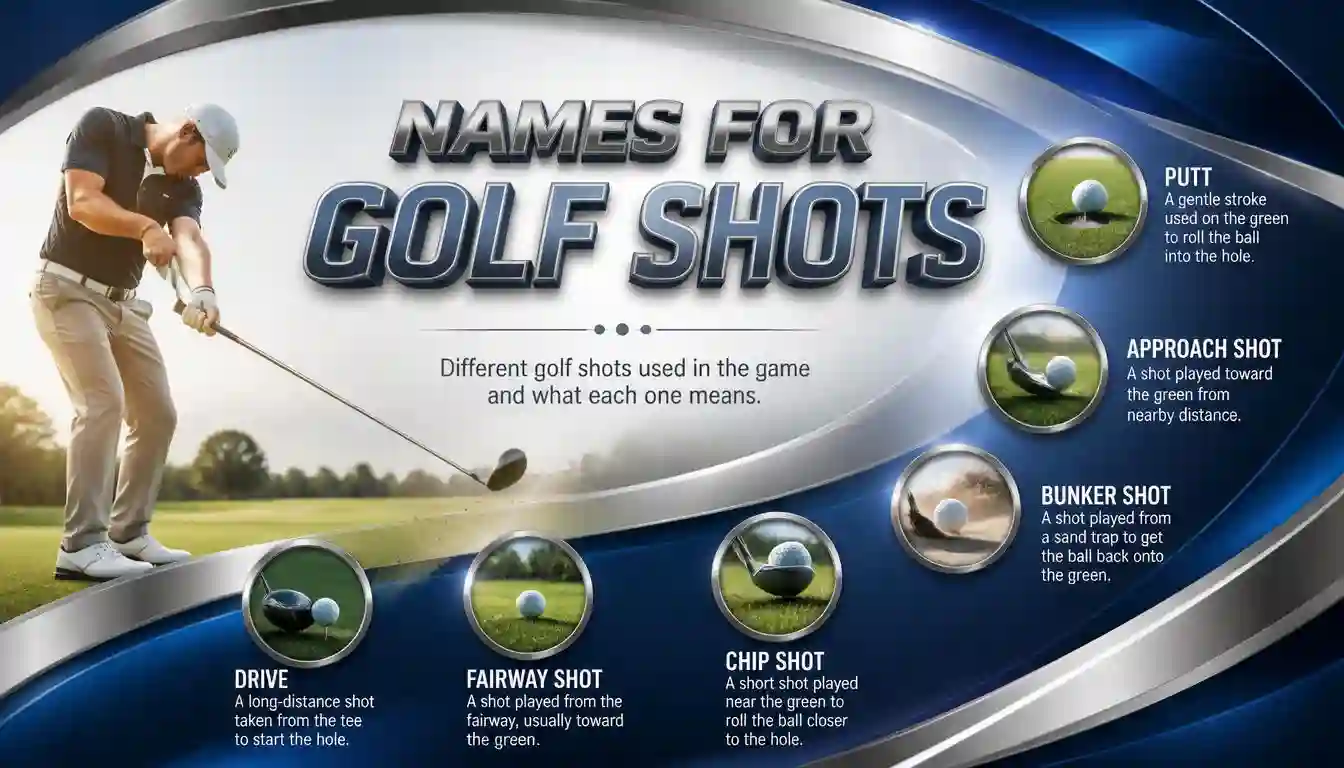
Golf has its own language, and some of the names for golf shots can sound confusing when you first hear them. A golfer might talk about a draw, fade, hook, slice, punch, stinger, flop shot, chip, pitch, or bump and run as if everyone already knows what they mean.
The good news is that golf shot names become much easier once you understand the basic categories. Some names Give detail where the ball goes, others describe how high it flies, while some describe the situation in which the shot is played.
This guide explains the most common golf shot names, different types of golf shots, golf shot terminology, and popular golf shots for beginners, with simple explanations of when each shot is useful.
What Are the Different Names for Golf Shots?
There are several ways to classify golf shots. A shot named according to its direction, curve, trajectory, purpose, location, or quality of contact.
For example:
- A draw curves gently from right to left for a right-handed golfer.
- A fade curves gently from left to right.
- A hook is a much stronger right-to-left curve.
- A slice is a much stronger left-to-right curve.
- A punch shot stays low.
- A flop shot flies high and lands softly.
- A chip shot is short and normally rolls more than it flies.
- A pitch shot flies higher and usually carries farther than a chip.
- A drive is normally a long tee shot.
- An approach shot is played toward the green.
These categories can overlap. For example, a golfer could hit a low draw, a high fade, or a punch shot that fades. Modern golf terminology often describes several characteristics of the same shot.
Common Golf Shot Names Every Golfer Should Know
If you’re learning golf vocabulary, start with the basic golf shot names below.
1. Drive
A drive is generally a long shot played from the tee, usually with a driver. On longer holes, the goal is normally to gain distance while keeping the ball in a useful position for the next shot.
2. Approach Shot
An approach shot is a shot intended to move the ball toward or onto the green. On a par-4, for example, the second shot is often an approach.
3. Chip Shot
A chip shot is a short shot played around the green. It normally flies a short distance and then rolls toward the hole.
4. Pitch Shot
A pitch shot is generally higher and spends more time in the air than a chip. It is useful when a golfer needs to carry some distance or an obstacle before landing near the hole.
5. Putt
A putt is a stroke played with a putter, normally on the putting green, with the goal of rolling the ball into the hole.
6. Bunker Shot
A bunker shot is played from a sand bunker. The golfer usually uses a technique designed to lift the ball out of the sand and onto the green or another safe area.
7. Recovery Shot
A recovery shot is played when a golfer is in trouble and needs to get the ball back into a good position. It may involve playing around a tree, out of rough, or away from another difficult area.
8. Layup Shot
A layup is a strategic shot in which the golfer deliberately stops short of a hazard, green, or other difficult target instead of taking a higher-risk shot.
Learning these basic golf shot types gives beginners a useful foundation for understanding golf conversations and course strategy.
Golf Shots Based on Ball Flight
Some of the most searched golf shot names describe the way the ball curves through the air.
For a right-handed golfer, the basic directions are:
| Golf shot | Typical ball movement |
| Straight shot | Little or no curve |
| Draw | Gentle right-to-left curve |
| Fade | Gentle left-to-right curve |
| Hook | Strong right-to-left curve |
| Slice | Strong left-to-right curve |
| Push | Starts right and stays right |
| Pull | Starts left and stays left |
The same concepts reverse for a left-handed golfer.
Straight Shot
A straight golf shot has relatively little sideways curve and generally starts and finishes close to the intended target line.
For beginners, learning to produce a reasonably predictable straight shot can make course management much easier.
Draw
A draw is a controlled curve that moves right to left for a right-handed golfer.
A draw is often an intentional shot shape. Golfers may use it when the hole layout favors a right-to-left flight or when they want a particular landing pattern.
Fade
A fade curves gently from left to right for a right-handed golfer.
Many golfers use a fade intentionally because it can offer a predictable shape and landing pattern. A fade should not automatically be confused with a slice.
Hook
A hook curves sharply from right to left for a right-handed golfer.
Unlike a controlled draw, a hook is usually much more aggressive and can cause the ball to finish far away from the intended target.
Slice
A slice curves sharply from left to right for a right-handed golfer.
A slice is one of the most familiar golf shot problems among recreational players. It can send the ball well away from the target and reduce both distance and accuracy.
Push
A push starts to the right of the intended target for a right-handed golfer and generally stays on that side without curving strongly back toward the target.
Pull
A pull starts to the left of the intended target for a right-handed golfer and generally stays left.
Pushes and pulls are useful terms because they describe the ball’s starting direction, while draw, fade, hook, and slice describe curvature.
Low and High Golf Shots
Not every golf shot is named because of its left-to-right or right-to-left movement. Some golf shot names describe trajectory.
Punch Shot
A punch shot is a low, controlled golf shot. It can be useful when a golfer needs to keep the ball underneath tree branches or reduce the effects of strong wind.
The goal is usually control rather than maximum height.
Stinger
A stinger is a low, penetrating golf shot designed to produce a relatively flat flight.
It is particularly associated with skilled golfers and is useful when a player wants a low flight that can work well in windy conditions.
Knockdown Shot
A knockdown shot is another type of lower-trajectory shot. Golfers use it when they want to reduce the height of the ball, often because of wind or obstacles.
The terms punch shot and knockdown shot can overlap, although golfers may use them slightly differently depending on the situation.
Flop Shot
A flop shot is a high, soft short-game shot designed to travel over an obstacle and land with very little rollout.
It can be useful when the golfer has little green to work with or needs to send the ball over a bunker or other obstacle.
Lob Shot
A lob shot is a very high short-game shot that is intended to land softly and stop relatively quickly.
It is particularly useful when the golfer needs to carry an obstacle while minimizing the amount of rollout after landing.
Golf Shots Around the Green
Short-game golf shots have their own vocabulary. Knowing the difference between these shots can help beginners choose better options around the green.
Chip Shot
A chip is generally low and spends more time rolling than flying.
It is often a good choice when there is plenty of green available between the ball and the hole.
Pitch Shot
A pitch flies higher and generally carries farther than a chip.
It can be useful when the golfer needs to carry rough, a slope, or another obstacle before reaching the putting surface.
Bump and Run
A bump and run is a low shot designed to land on the ground and roll toward the hole.
It is similar to a chip but is often discussed specifically as a strategy for getting the ball onto the green and allowing it to roll a significant distance.
Lob Shot
A lob shot sends the ball high into the air and is designed for a softer landing.
It can be helpful when the golfer needs to clear an obstacle or has very little room for the ball to roll.
Flop Shot
The flop shot is a more specialized high, soft shot. It can be effective in difficult short-game situations, but it requires good technique and control.
Bunker Shot
A bunker shot is played from sand. The golfer’s objective is usually to get the ball safely out of the bunker and onto a playable area, often the green.
Golf Shots From the Tee to the Green
One of the easiest ways to understand golf shot terminology is to follow a typical hole.
From the Tee
Common names include:
- Drive
- Tee shot
- Stinger
- Power drive
- Shaped drive
The tee shot is simply the shot played from the teeing area. A drive is generally a long tee shot, often played with a driver.
From the Fairway or Rough
Common shots include:
- Approach shot
- Full shot
- Knockdown shot
- Punch shot
- Layup
- Recovery shot
The choice depends on distance, lie, obstacles, wind, and the golfer’s desired target.
Around the Green
Common names include:
- Chip
- Pitch
- Bump and run
- Flop
- Lob
- Bunker shot
On the Green
The main shot is the putt, although golfers may use different putting terms such as lag putt for a longer putt where getting close to the hole is the primary goal.
Golf Shot Names for Beginners
Beginners don’t need to master every specialty shot immediately. Start by understanding these essential golf shots:
- Drive — a long tee shot.
- Approach — a shot played toward the green.
- Straight shot — little or no intentional curve.
- Draw — controlled right-to-left curve for a right-handed golfer.
- Fade — controlled left-to-right curve for a right-handed golfer.
- Chip — short, low shot around the green.
- Pitch — higher short-game shot.
- Bunker shot — shot played from sand.
- Punch shot — low shot used to avoid wind or obstacles.
- Putt — stroke used to roll the ball toward the hole.
Once these names make sense, terms such as hook, slice, stinger, flop shot, knockdown, layup, and recovery shot become much easier to understand.
Draw vs Fade, Hook vs Slice, and Other Golf Shot Differences
Some golf shot names are confusing because they describe similar movements.
Draw vs Fade
For a right-handed golfer:
- Draw: curves right to left.
- Fade: curves left to right.
Both can be intentional and useful shot shapes.
Hook vs Slice
A hook is a much stronger right-to-left curve.
A slice is a much stronger left-to-right curve.
The important distinction is that a draw and fade are commonly discussed as controlled shapes, while a hook or slice often describes a more exaggerated curve.
Push vs Pull
A push starts right and stays right for a right-handed golfer.
A pull starts left and stays left.
Unlike a draw or fade, the key feature here is the starting direction rather than a significant curve.
Chip vs Pitch
A chip normally stays lower and rolls more after landing.
A pitch generally flies higher and spends more time in the air before landing.
This is one of the most important short-game distinctions for beginners.
Pitch vs Lob
A pitch is generally a moderately high short-game shot.
A lob is designed to fly much higher and land more softly, especially when the golfer needs to clear an obstacle.
Punch Shot vs Stinger
Both are associated with low ball flight.
A punch is commonly used as a practical low shot to escape trouble or deal with wind. A stinger is generally described as a particularly low, penetrating shot with a strong, controlled flight.
Common Golf Shot Slang and Mishit Names
Golfers also use informal names for certain shots. These terms can vary between groups and regions, so they are not always as standardized as terms such as draw or fade.
Some common examples include:
- Worm burner — a very low shot that skims close to the ground.
- Banana ball — an exaggerated slice.
- Hosel rocket — slang for a shank.
- Shank — a shot struck near the hosel.
- Chili dip — a chunked short shot.
- Skull — a thinly struck shot.
- Bladed shot — a shot struck with the leading edge.
- Topped shot — contact near the top of the ball.
- Duff or chunk — a shot where the club hits the ground before the ball.
- Whiff — a complete miss where the club fails to make contact.
- Texas wedge — using a putter from off the green.
- Duck hook — a severe, low hook.
- Double cross — attempting one shot shape but producing the opposite curve.
- Flyer — a shot from rough that travels farther than expected.
- Splash — a bunker shot that sends sand and ball out together.
These expressions are part of golf slang rather than a formal classification system, and different golfers may use some terms differently.
How to Choose the Right Golf Shot
Choosing the right golf shot is about more than knowing the name.
Before hitting the ball, consider:
1. Distance
How far do you need the ball to travel?
A long approach may require a full shot, while a short shot around the green may call for a chip or pitch.
2. Wind
Strong wind can make a high shot difficult to control. A punch, knockdown, or stinger may be a better strategic option in certain conditions.
3. Obstacles
Trees, bunkers, water, slopes, and other hazards can change the best choice.
Sometimes the smartest play is not the most aggressive shot.
4. Lie
A ball sitting cleanly in the fairway gives you different options from a ball sitting in deep rough or sand.
5. Green Position
Look at how much green is available between your ball and the hole.
If there is plenty of room to roll, a chip or bump and run may work well. If you need the ball to stop quickly, a higher pitch or lob may be more appropriate.
6. Risk vs Reward
Good course management means choosing a shot that gives you a realistic chance of success.
A layup or recovery shot can sometimes be better than attempting a difficult shot that could bring a penalty or another poor lie into play.
What Makes a Good Golf Shot?
A good golf shot is not necessarily the longest shot.
The best shot is usually one that matches the situation and leaves the ball in a favorable position for the next stroke.
For example:
- A drive should balance distance and accuracy.
- An approach shot should give you a realistic chance to reach the desired target.
- A chip should provide predictable rollout.
- A pitch should give you useful height and distance control.
- A punch shot should safely avoid an obstacle.
- A recovery shot should get you back into play.
- A putt should have the right pace and starting line.
Understanding this idea is more valuable than simply memorizing dozens of golf shot names.
Golf Shots Every Golfer Should Learn
If you’re building your golf skills, focus on shots that appear regularly during a normal round.
A useful progression is:
Straight shot → Drive → Approach → Chip → Pitch → Bunker shot → Draw → Fade → Punch → Recovery shot
After these become comfortable, you can explore more specialized shots such as:
- Stinger
- Flop shot
- Lob shot
- Knockdown
- Bump and run
- Shaped drives
- Specialty recovery shots
This approach helps beginners develop practical skills instead of trying to learn every golf shot at once.
Frequently Asked Questions About Golf Shot Names
What are the main types of golf shots?
The main types include drives, approach shots, chips, pitches, putts, bunker shots, recovery shots, draws, fades, hooks, slices, punch shots, stingers, flop shots, and lob shots.
What is the most common golf shot?
There is no single shot that is most important in every situation. Drives are common from the tee, approach shots are common during the journey to the green, and putts are essential once the ball is on the putting surface.
What is a draw in golf?
A draw is a controlled shot that curves from right to left for a right-handed golfer. For a left-handed golfer, the direction is reversed.
What is a fade in golf?
A fade is a controlled shot that curves from left to right for a right-handed golfer.
What is the difference between a hook and a slice?
A hook curves sharply right to left for a right-handed golfer, while a slice curves sharply left to right. Both are stronger curves than a typical draw or fade.
What is a punch shot in golf?
A punch shot is a low-trajectory shot used when a golfer wants to keep the ball underneath obstacles or reduce its exposure to wind.
What is a stinger shot?
A stinger is a low, penetrating shot that is designed to produce a controlled flight and significant rollout. It is particularly useful in windy conditions and is strongly associated with skilled golfers.
What is the difference between a chip and a pitch?
A chip generally flies lower and rolls farther after landing. A pitch generally flies higher and carries farther before landing.
What is a flop shot?
A flop shot is a high, soft short-game shot designed to clear an obstacle and land with minimal rollout.
What is a bump and run in golf?
A bump and run is a low shot that lands on the ground and rolls toward the hole. It can be useful when there is plenty of green available.
What golf shots should beginners learn first?
Beginners should first understand the drive, straight shot, approach shot, chip, pitch, putt, bunker shot, draw, fade, and basic recovery shot. These provide a strong foundation for understanding golf strategy and terminology.
Final Thoughts on Names for Golf Shots
Learning the names for golf shots makes the game easier to understand and can also help you make better decisions on the course. Start with the basics: drive, approach, chip, pitch, putt, draw, fade, hook, slice, punch, and bunker shot.
Then build your vocabulary with more specialized terms such as stinger, flop shot, lob shot, knockdown, bump and run, layup, and recovery shot.
The key is to remember that golf shots can be classified in different ways. Draws and fades describe curve, punches and stingers describe trajectory, chips and pitches describe short-game situations, while drives and approaches describe the purpose of the shot. Once you understand these categories, golf terminology becomes much easier to follow.