








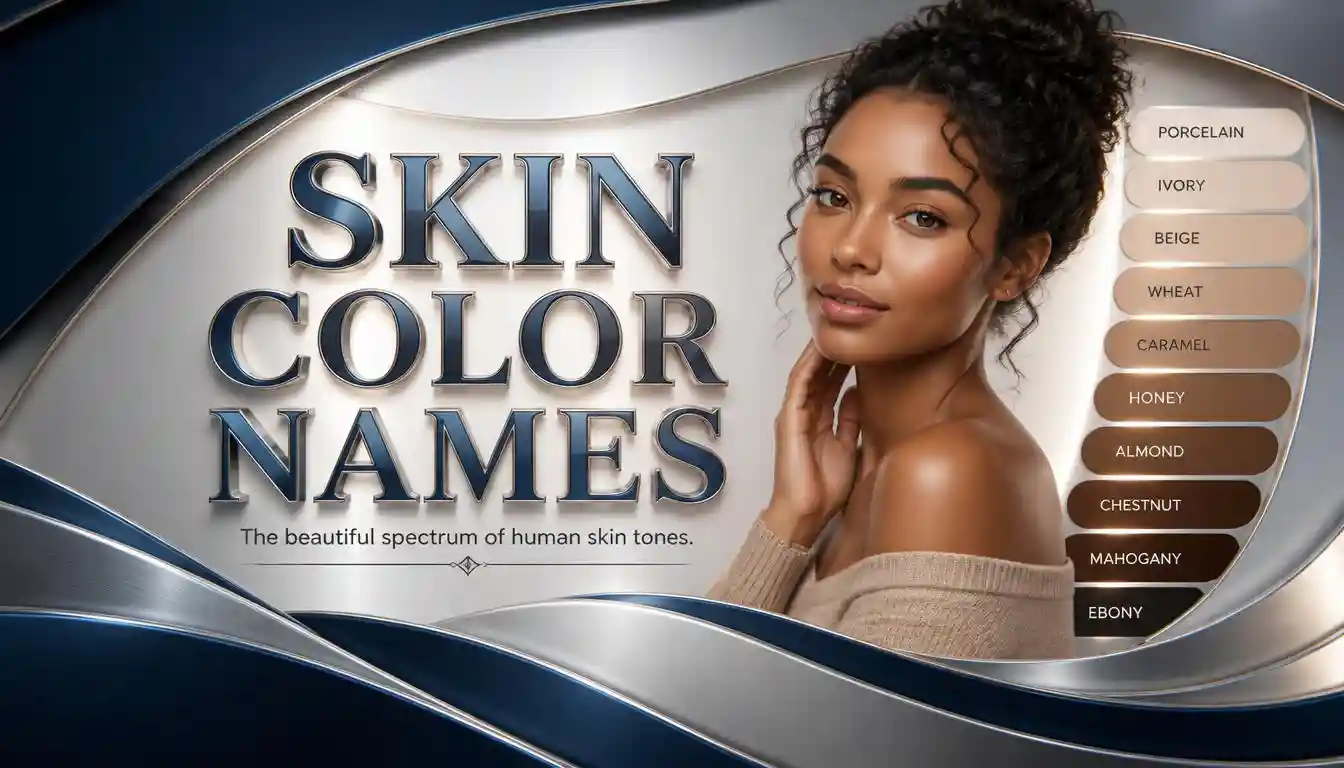
Skin color names help us describe the wide range of natural complexions people have, from porcelain and ivory to honey, caramel, cocoa, mahogany, and ebony. These names are commonly used in beauty, fashion, art, writing, illustration, photography, and everyday descriptions.
However, skin color is more than a simple list of light and dark shades. A useful description can include skin depth, visible color, and undertone. For example, someone might have medium skin with a warm golden undertone, while another person may have a similar depth with a cool or neutral undertone.
There is no single universal dictionary that determines exactly where one descriptive shade name ends and another begins. Terms such as beige, honey, caramel, mocha, and cocoa can overlap, and different brands and color charts may use them differently.
What Are Skin Color Names?
Skin color names are descriptive words used to communicate the visible appearance of human skin. Common examples include porcelain, ivory, fair, beige, sand, honey, golden, almond, olive, tan, caramel, bronze, chestnut, cinnamon, mocha, cocoa, mahogany, espresso, and ebony.
These names are useful because saying “light brown with a warm undertone” can communicate more information than simply saying “brown.”
It is also important to understand that these are descriptive skin color names rather than universally standardized categories. A shade called “honey” by one cosmetics company may look slightly different from a shade called “honey” by another.
A skin tone chart can therefore be helpful as a visual reference, but a name by itself should not be treated as an exact scientific measurement.
Skin Color Names From Fair to Deep
One simple way to understand different skin color names is to arrange them approximately by visible depth.
The categories below are useful for general description, but natural skin exists on a continuous spectrum. People can also fall between categories.
Fair Skin Color Names
Common names for very light complexions include:
- Porcelain
- Alabaster
- Ivory
- Fair
- Cream
Porcelain usually suggests a very light complexion and is often used in fashion, beauty, and creative writing.
Alabaster is another literary and descriptive term for very light skin.
Ivory often suggests a light complexion with a creamy or slightly warm appearance.
Fair is a broad everyday term rather than a precise color measurement.
Cream can describe a soft, light complexion with a warm appearance.
Light Skin Color Names
Some common light skin shades include:
- Light beige
- Beige
- Sand
- Nude
- Cream
- Warm ivory
These names are frequently used in cosmetics, fashion, illustration, and character descriptions.
Medium Skin Color Names
Medium complexions may be described with terms such as:
- Honey
- Golden
- Almond
- Beige
- Warm beige
- Golden beige
- Olive
Honey usually suggests a warm golden appearance.
Almond is commonly used as a soft medium beige or light-brown descriptive term.
Golden emphasizes yellow or warm undertones rather than simply describing depth.
Tan Skin Color Names
Common names associated with tan complexions include:
- Tan
- Caramel
- Amber
- Bronze
- Golden brown
- Warm sand
Caramel generally suggests a warm medium-to-deep complexion.
Amber often conveys a rich golden or yellow-brown appearance.
Bronze is commonly associated with a deeper, warm, sun-kissed appearance.
Brown Skin Color Names
Brown skin can be described using many different terms, including:
- Chestnut
- Cinnamon
- Pecan
- Mocha
- Sienna
- Walnut
- Cocoa
- Chocolate
These names should be treated as descriptive vocabulary rather than strict categories. A person can also have warm, cool, neutral, or olive characteristics within a similar depth.
Deep Skin Color Names
Common descriptive names for deeper complexions include:
- Cocoa
- Mahogany
- Umber
- Espresso
- Ebony
- Deep brown
- Rich brown
Mahogany often suggests a deep reddish-brown appearance.
Umber is a traditional earthy brown color term.
Espresso is commonly used as a very deep brown descriptive name.
Ebony is traditionally associated with an extremely deep, dark brown or black appearance.
Skin Tone Names and Undertones
A major part of understanding skin tone names is knowing the difference between depth and undertone.
Skin depth describes how light or deep the complexion appears. Undertone describes the subtle color direction underneath the visible surface.
In beauty and color-analysis contexts, undertones are commonly described as:
- Warm
- Cool
- Neutral
- Olive
Recent skin-tone resources similarly separate depth from undertone because two people can have a similar overall depth while having noticeably different underlying color characteristics.
Warm Skin Tone Names
Warm skin tones often have golden, yellow, peach, or warm-looking characteristics.
Descriptive names may include:
- Golden
- Honey
- Warm beige
- Caramel
- Amber
- Bronze
- Golden brown
For example:
Medium skin with a warm golden undertone is more specific than simply saying “medium skin.”
Cool Skin Tone Names
Cool undertones are often described using pink, rosy, reddish, or bluish characteristics.
Useful descriptive terms include:
- Rosy
- Pink-beige
- Cool beige
- Cool brown
- Reddish brown
A cool undertone does not necessarily mean that the person’s overall complexion is light. Cool undertones can occur across different depths.
Neutral Skin Tone Names
Neutral undertones sit between clearly warm and cool characteristics.
Possible descriptions include:
- Neutral beige
- Neutral tan
- Neutral brown
- Balanced beige
- Neutral deep brown
Someone with a neutral undertone may not see an obvious golden, yellow, pink, or red cast.
Olive Skin Tone Names
A Olive is a commonly used term for a complexion with a greenish, muted, or yellow-green cast.
A Olive should not simply be treated as another level of lightness or darkness. It is more useful to think of it as a color direction or undertone description that can appear across different depths.
This is one reason a person can have light olive, medium olive, tan olive, or deeper olive characteristics.
Skin Color Chart With Names
The following skin color chart provides a simple vocabulary reference:
| Approximate depth | Common skin color names | Possible undertones |
| Very fair | Porcelain, alabaster | Cool, neutral |
| Fair | Ivory, fair, cream | Warm, cool, neutral |
| Light | Beige, sand, nude | Warm, cool, neutral |
| Light-medium | Golden beige, almond, honey | Warm, neutral |
| Medium | Honey, beige, golden, olive | Warm, neutral, olive |
| Tan | Caramel, amber, bronze | Warm, neutral, olive |
| Medium-brown | Chestnut, cinnamon, pecan | Warm, neutral, cool |
| Brown | Mocha, walnut, sienna, cocoa | Warm, neutral, cool |
| Deep brown | Mahogany, umber, espresso | Warm, neutral, cool |
| Very deep | Ebony, deep brown, rich brown | Warm, neutral, cool |
Remember that these categories overlap. A “caramel” complexion can look different depending on lighting, undertone, and the reference chart being used. Current skin-tone references likewise describe these names as flexible descriptive vocabulary rather than universal scientific labels.
What Is the Difference Between Skin Color, Skin Tone, and Undertone?
These terms are often used interchangeably, but they can describe different things.
Skin color generally refers to the visible color of the skin.
Skin tone is often used to describe the overall depth or appearance of the complexion, such as fair, light, medium, tan, brown, or deep.
Undertone describes the underlying color direction, commonly expressed as warm, cool, neutral, or olive in beauty and color-analysis settings.
For example, two people might both have medium skin, but one could have a warm golden undertone while the other has a cool or neutral undertone.
This is why foundation matching and color descriptions often consider both depth and undertone, rather than relying on a single skin color name.
Skin Color Names With Pictures: Why Visual References Help
If you search for skin color names with pictures, you will notice that images make shade names much easier to understand.
Words such as “beige,” “honey,” “caramel,” “cocoa,” and “espresso” can create different mental images for different people. A labeled visual chart provides a shared reference.
For this reason, a good skin tone chart with names should ideally show:
- The shade name
- Approximate depth
- Undertone
- A representative color swatch
- A clear explanation of its limitations
Screen displays can also change how a color appears. Lighting, photography, camera settings, and display calibration can all influence perceived color. So a digital chart should be used as a reference rather than as an exact measurement of someone’s complexion.
Different Skin Tones and Their Names
There are many ways to group different skin tones. A simple descriptive system can include:
Very Fair and Fair
Porcelain, alabaster, ivory, fair, cream.
Light
Light beige, sand, nude, warm ivory.
Medium
Beige, almond, honey, golden, olive.
Tan
Tan, caramel, amber, bronze, golden brown.
Brown
Chestnut, cinnamon, pecan, mocha, walnut, sienna.
Deep Brown
Cocoa, mahogany, umber, espresso, rich brown.
Very Deep
Ebony, deep brown, very deep cocoa, rich espresso.
These names are useful for general description, but they should not be treated as a rigid classification system.
How to Identify Your Skin Tone
If you are trying to determine which skin color name best describes you, start with your overall depth and then consider your undertone.
1. Look at Your Skin in Natural Light
Artificial lighting can make skin appear more yellow, pink, orange, or gray. Natural daylight usually provides a more useful reference.
2. Look at More Than Your Face
Your face can have temporary changes caused by sun exposure, redness, skincare products, or other factors. Looking at your neck and nearby areas can provide additional context.
3. Determine Your Approximate Depth
Ask whether your complexion appears:
- Very fair
- Fair
- Light
- Light-medium
- Medium
- Tan
- Brown
- Deep
- Very deep
4. Consider Your Undertone
Look for characteristics that appear consistently warm, cool, neutral, or olive.
5. Compare Several Shades
Don’t rely on one photograph or one online swatch. Compare several shades under similar lighting.
For makeup matching, current professional guidance commonly recommends checking foundation along the jawline and considering the neck and chest rather than judging only the face.
Skin Tone Names for Makeup and Foundation
Skin color names are widely used in cosmetics because shoppers need a simple way to understand foundation and concealer shades.
You may see names such as:
- Porcelain
- Ivory
- Nude
- Beige
- Warm Beige
- Golden
- Sand
- Tan
- Caramel
- Honey
- Almond
- Bronze
- Cocoa
- Chestnut
- Mahogany
- Espresso
- Ebony
However, cosmetic shade names are brand-specific. A “medium beige” from one company may not match the “medium beige” from another.
Some product ranges also combine shade names with undertone descriptions, such as warm, cool, neutral, or olive. This is generally more informative than the shade name alone.
Skin Color Names for Art, Drawing, and Writing
Artists, illustrators, writers, and character designers often need descriptive skin color names.
Instead of using a single generic word, you can combine depth and undertone.
For example:
- Light skin with a cool rosy undertone
- Fair skin with a neutral undertone
- Warm ivory complexion
- Light beige with golden undertones
- Medium honey-brown skin
- Warm caramel complexion
- Medium olive-brown skin
- Deep cocoa skin with a neutral undertone
- Rich mahogany-brown skin
- Deep espresso complexion
This approach gives readers a clearer mental picture.
For creative writing, the best description depends on the scene. A simple, respectful description is often more effective than filling a paragraph with decorative color comparisons.
What Makes a Good Skin Color Description?
A useful description should be:
- Clear
- Specific
- Context-appropriate
- Respectful
- Easy to visualize
- Based on observable characteristics
For example, “medium brown skin with warm golden undertones” communicates more information than simply saying “brown skin.”
Similarly, “fair skin with a cool rosy undertone” gives a reader a clearer idea of both depth and color direction.
Skin color should also not automatically be used as a substitute for someone’s race, ethnicity, nationality, or identity. People within the same ethnic or geographic group can have a wide range of complexions.
Are Skin Color Names Scientifically Standardized?
No. Everyday names such as porcelain, honey, caramel, mocha, cocoa, and ebony are primarily descriptive terms.
There are, however, formal systems used for specific purposes.
One well-known example is the Fitzpatrick skin phototype classification, which uses six types, from I through VI. Unlike ordinary descriptive shade names, it focuses heavily on how skin responds to ultraviolet exposure, particularly its tendency to burn and tan.
That means a Fitzpatrick type should not simply be treated as another name for a cosmetic shade.
Are Skin Color Names the Same as Fitzpatrick Skin Types?
No.
The Fitzpatrick system is a skin phototype system, not simply a list of color names.
Its six categories are based largely on sun response:
| Fitzpatrick type | General description | Typical sun response |
| I | Very pale | Usually burns and does not tan |
| II | Fair | Burns easily and tans minimally |
| III | Light to medium | May burn and gradually tans |
| IV | Light brown | Burns less easily and tans readily |
| V | Brown | Rarely burns and tans readily |
| VI | Deeply pigmented | Rarely or never burns and tans deeply |
The Fitzpatrick classification was developed around response to sunlight, so it should not be confused with a universal skin color chart with names. Dermatology references continue to describe it as a phototype system.
How Should You Describe Someone’s Skin Color?
When describing a person’s complexion, choose language that is relevant to the situation and avoid assuming that a single color name completely defines someone.
For fiction, you might write:
“She had medium-brown skin with warm golden undertones.”
For an art reference:
“Deep brown skin with a neutral undertone.”
For makeup:
“Medium skin with a warm olive undertone.”
For general conversation, a simple description may be enough.
The goal is not to find one “perfect” skin color name. The goal is to communicate appearance accurately and respectfully.
Common Skin Color Names and Their Meanings
Here is a quick reference to some widely used names:
Porcelain
A very light descriptive term often associated with a pale, delicate appearance.
Ivory
A light, creamy descriptive shade that may lean warm or neutral.
Beige
A broad light-to-medium neutral-looking color term.
Sand
Usually suggests a light or medium warm beige appearance.
Honey
A warm golden shade name often associated with medium complexions.
Almond
A soft beige-to-brown descriptive term.
Olive
A complexion or undertone with muted yellow-green characteristics.
Caramel
A warm medium-to-deep golden-brown shade.
Amber
A warm golden-brown descriptive color.
Bronze
A deeper warm, golden-brown shade.
Chestnut
A medium-to-deep brown with a rich earthy appearance.
Cinnamon
A warm reddish-brown descriptive term.
Mocha
A medium-to-deep brown shade name inspired by coffee.
Cocoa
A rich brown descriptive term.
Mahogany
A deep reddish-brown color name.
Umber
A deep earthy brown color term.
Espresso
A very deep brown descriptive name.
Ebony
A very deep dark brown or black descriptive term.
Frequently Asked Questions About Skin Color Names
What are the different skin color names?
Common descriptive names include porcelain, ivory, fair, beige, sand, honey, golden, almond, olive, tan, caramel, amber, bronze, chestnut, cinnamon, mocha, cocoa, mahogany, umber, espresso, and ebony.
What are the different skin tone names?
Common skin tone names include fair, light, medium, tan, brown, deep, and very deep. More descriptive terms include ivory, beige, honey, caramel, cocoa, mahogany, and espresso.
What are the names of light skin tones?
Common names include porcelain, alabaster, ivory, fair, cream, light beige, sand, and nude.
What are the names of medium skin tones?
Examples include beige, almond, honey, golden, tan, olive, caramel, and amber.
What are the names of deep skin tones?
Common descriptive names include cocoa, mahogany, umber, espresso, ebony, and deep brown.
What is an olive skin tone?
Olive usually describes a complexion with a muted yellow-green or greenish cast. It can occur at different levels of skin depth.
What is the difference between skin tone and undertone?
Skin tone generally refers to the overall visible depth of the complexion, while undertone describes the underlying color direction, often described as warm, cool, neutral, or olive.
Are skin color names universal?
No. Everyday skin color names are descriptive and can vary between people, industries, cosmetics brands, charts, and cultures.
How do I know my skin tone?
Look at your complexion in natural light, determine your approximate depth, and then consider whether your undertone appears warm, cool, neutral, or olive.
What skin color names are used for foundation?
Common cosmetic names include porcelain, ivory, nude, beige, sand, honey, golden, tan, caramel, almond, bronze, cocoa, mahogany, espresso, and ebony. Exact shades vary between brands.
What are good skin color names for art?
Artists can use terms such as ivory, beige, honey, golden brown, caramel, bronze, chestnut, mocha, cocoa, mahogany, and espresso. Combining a shade name with an undertone can make the description more precise.
What are good skin color names for writing?
For writing, natural combinations such as “fair skin with cool undertones,” “warm honey-brown skin,” or “deep brown skin with neutral undertones” can provide a clearer image than relying on a single poetic color name.
Is Fitzpatrick the same as a skin color chart?
No. Fitzpatrick types I–VI primarily classify how skin reacts to ultraviolet exposure, especially burning and tanning. A descriptive skin color chart focuses more directly on visible color and shade vocabulary.
Final Thoughts on Skin Color Names
There are many skin color names, and no single list can capture every natural complexion. Terms such as porcelain, ivory, beige, honey, golden, olive, caramel, bronze, chestnut, cinnamon, mocha, cocoa, mahogany, espresso, and ebony are useful descriptive vocabulary, but their meanings can overlap.
The easiest way to understand skin color is to consider two dimensions: overall depth and undertone. A description such as “medium skin with a warm golden undertone” is often more informative than a single shade name.
Whether you are searching for skin color names with pictures, a skin color chart, skin tone names, skin shades for makeup, skin color names for art, or descriptive terms for writing, the most useful approach is to treat these names as flexible visual references rather than rigid scientific categories.

I’m Shahid Imran, the creator of Reachora Media, a website dedicated to names, their meanings, origins, pronunciations, and interesting name-related information. Explore my website to discover meaningful and unique names with helpful, easy-to-understand details: Reachora Media