









Rain bow colors are one of nature’s most beautiful sights. From bright red and cheerful orange to calming blue and lovely violet, the colors of the rainbow create a stunning display across the sky. Whether you want to learn the seven rainbow colors, understand their meanings, discover how rainbows form, or teach children to recognize colors, this guide covers everything you need to know.
The traditional rain bow color sequence includes red, orange, yellow, green, blue, indigo, and violet. Each color has its own appearance and wavelength within the visible light spectrum. In this article, you will discover the seven colors of the rainbow in order, their names and symbolic meanings, interesting rainbow facts, and easy ways to remember the color sequence.
What Are the Seven Colors of the Rainbow?
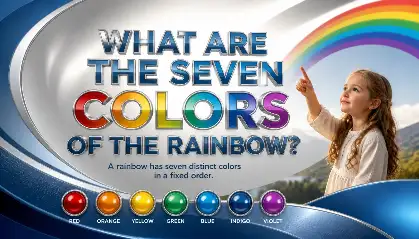
The seven colors of the rain bow are red, orange, yellow, green, blue, indigo, and violet. These colors are traditionally used to describe the visible spectrum that appears when sunlight passes through water droplets under suitable conditions.
A rainbow forms when sunlight interacts with tiny water droplets in the atmosphere. The light bends as it enters each droplet, separates into different wavelengths, reflects inside the droplet, and bends again as it leaves. This process produces the colorful arc that we see in the sky.
Although people traditionally identify seven rainbow colors, the spectrum itself is continuous. The colors gradually blend into one another rather than appearing as seven perfectly separated bands.
What Are the 7 Colors of the Rainbow in Order?
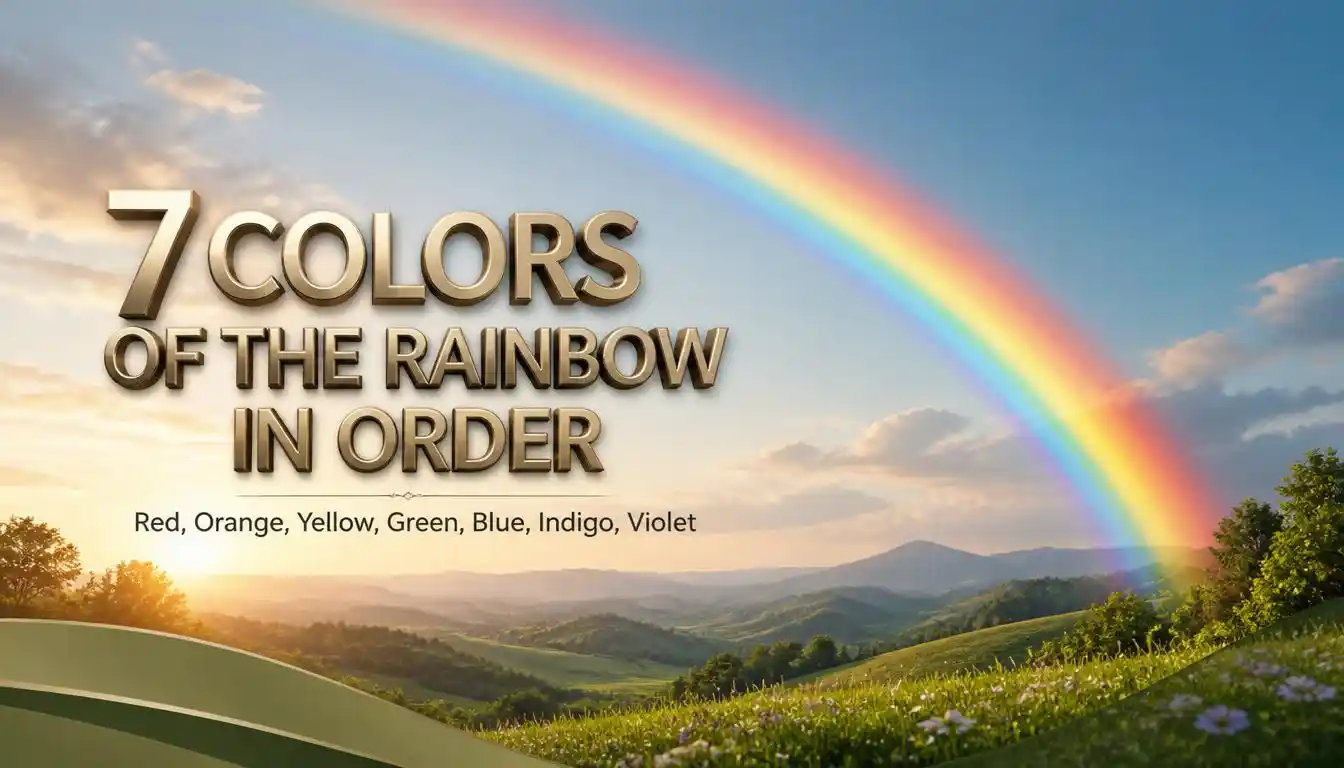
The traditional rainbow color order begins with red on the outer edge of a primary rainbow and ends with violet on the inner edge.
| Order | Rainbow Color | General Appearance |
| 1 | Red | Bright, warm red |
| 2 | Orange | A blend of red and yellow |
| 3 | Yellow | Bright and sunny |
| 4 | Green | Fresh and natural |
| 5 | Blue | Cool and sky-like |
| 6 | Indigo | Deep blue-violet |
| 7 | Violet | Purple with a bluish tone |
These seven rainbow color names are widely taught in schools and used in educational charts, coloring books, and science lessons.
1. Red: The First Rainbow Color

Red is the first color in the traditional rainbow sequence when viewed from the outer edge of a primary rainbow. It has the longest wavelengths among the seven traditionally named colors.
Red is a bold, noticeable color often associated with energy, warmth, love, courage, and excitement. In a rainbow, it creates a striking outer band that stands out against the sky.
2. Orange: The Second Rainbow Color

Orange appears between red and yellow. It combines the warmth of red with the brightness of yellow, giving it a cheerful and lively appearance.
Orange is commonly associated with creativity, enthusiasm, friendliness, and warmth. Its position in the rainbow creates a smooth transition between the red and yellow bands.
3. Yellow: The Third Rainbow Color

Yellow is the third traditionally named rainbow color. It is bright and easy to recognize, especially when the rainbow appears against a dark cloud or rainy sky.
Yellow often symbolizes happiness, optimism, sunshine, and positivity. It adds a brilliant touch to the rainbow and helps create its familiar sequence of warm colors.
4. Green: The Fourth Rainbow Color

Green appears between yellow and blue. It is one of the most recognizable colors in nature and can be seen in grass, leaves, plants, and forests.
Green is frequently associated with growth, renewal, balance, and nature. In the rainbow spectrum, it forms the transition from the warmer colors to the cooler colors.
5. Blue: The Fifth Rainbow Color

Blue appears after green and before indigo in the traditional seven-color sequence. It is associated with the sky, oceans, and clear water.
Blue commonly represents calmness, peace, trust, and stability. Its cool appearance provides a beautiful contrast to the warmer red, orange, and yellow bands.
6. Indigo: The Sixth Rainbow Color

Indigo is traditionally placed between blue and violet. It is a deep blue-violet color that can be difficult to distinguish clearly in some natural rainbows.
Indigo is often associated symbolically with depth, reflection, and mystery. Although it is included in the traditional seven-color list, the boundary between indigo and neighboring shades is not sharply defined in the continuous spectrum.
7. Violet: The Seventh Rainbow Color
Violet is the final color in the traditional rainbow sequence when moving from the outer edge toward the inner edge of a primary rainbow. It has shorter wavelengths than the other traditionally named rainbow colors.
Violet is often associated with imagination, creativity, elegance, and mystery. Its distinctive bluish-purple appearance completes the familiar rainbow color sequence.
Rainbow Colors and Their Meanings
Rainbow colors can have different symbolic meanings in art, culture, design, and everyday communication. These associations are not universal scientific rules, but they can help explain why people connect particular colors with certain feelings.
Red, Orange, and Yellow: Warm Rainbow Colors
Red is commonly associated with love, passion, strength, and courage.
Orange often represents enthusiasm, creativity, friendliness, and energy.
Yellow is frequently linked with happiness, hope, sunshine, and optimism.
Together, these warm colors can create a lively and welcoming appearance in illustrations, decorations, artwork, and educational materials.
Green and Blue: Natural and Calming Rain bow Colors
Green often represents nature, growth, freshness, and renewal.
Blue is commonly associated with peace, trust, calmness, and openness.
These colors appear frequently in nature and can give rainbow artwork a balanced, soothing appearance.
Indigo and Violet: Deep and Imaginative Rain bow Colors
Indigo can symbolize depth, reflection, and mystery.
Violet is often connected with imagination, creativity, individuality, and elegance.
These deeper shades add contrast to the rainbow and complete its traditional seven-color sequence.
The Science Behind a Rainbow
A rainbow is a beautiful natural optical phenomenon that occurs when sunlight interacts with tiny water droplets in the atmosphere. The science behind a rainbow involves three main processes: refraction, dispersion, and internal reflection. Together, these processes separate white sunlight into the different colors we see in a rainbow.
1. Refraction: How Sunlight Bends
When sunlight enters a water droplet, it changes speed and bends. This process is called refraction. Because different wavelengths of light bend by different amounts, the sunlight begins to separate into its component colors.
2. Dispersion: How White Light Separates Into Colors
Sunlight may look white, but it contains a range of visible wavelengths. As light passes through a water droplet, these wavelengths bend by slightly different amounts. This separation is called dispersion.
The resulting spectrum includes the seven traditionally named rainbow colors: red, orange, yellow, green, blue, indigo, and violet. In reality, the colors blend continuously rather than forming seven perfectly separated bands.
3. Internal Reflection: How Light Travels Inside a Droplet
After entering a raindrop, light reflects off the inside surface before leaving the droplet. This is called internal reflection. As the light exits, it refracts again, sending different colors in particular directions toward an observer.
When millions of water droplets direct light toward your eyes at the correct angles, you see a colorful arc across the sky.
Why Does a Rainbow Have Seven Colors?
The traditional seven-color model describes the rainbow as red, orange, yellow, green, blue, indigo, and violet. However, a rainbow actually contains a continuous spectrum of visible light, with countless shades blending into one another.
Red appears on the outer edge of a primary rainbow because it leaves the droplets at a slightly different angle from violet, which appears on the inner edge.
Why Do You See a Rainbow After Rain?
Rainbows often appear when sunlight shines through water droplets left in the air after rainfall. To see one, you generally need:
- Sunlight behind you.
- Water droplets in front of you.
- The Sun relatively low in the sky for a typical high, visible rainbow.
The droplets act like tiny prisms, separating sunlight into colors and directing them toward your eyes.
Why Is a Rainbow Curved?
A rainbow appears curved because the colored light reaches your eyes from droplets located at particular angles around the point opposite the Sun. The full shape is a circle, but the ground usually hides the lower portion, making it look like an arc.
From an airplane or another high viewpoint, a full circular rainbow may sometimes be visible under suitable conditions.
In simple words: A rainbow forms when sunlight enters raindrops, bends, separates into colors, reflects inside the droplets, and bends again as it comes out. Millions of droplets working together create the colorful rainbow we see in the sky.
Why Does a Rainbow Have Seven Colors?
A rainbow is created when sunlight interacts with water droplets suspended in the air. White sunlight contains a mixture of visible wavelengths, and the droplets separate this light into its component colors.
The traditional classification identifies seven main colors: red, orange, yellow, green, blue, indigo, and violet. This classification is useful for teaching and remembering the sequence, but the natural spectrum contains a continuous range of colors.
How Sunlight Creates Rainbow Colors
Three important optical processes help produce a primary rainbow:
- Refraction: Sunlight bends as it enters a water droplet.
- Dispersion: Different wavelengths bend by different amounts, separating the light into colors.
- Internal reflection and refraction: Light reflects inside the droplet and bends again as it exits toward the observer.
Millions of droplets can send different colors of light toward your eyes, creating the familiar rainbow arc.
Why Do Rainbow Colors Appear in a Specific Order?
The colors appear in a consistent order because different wavelengths of light bend by different amounts as they pass through water droplets.
Red light generally appears along the outer edge of a primary rainbow, while violet appears along the inner edge. In a secondary rainbow, the order is reversed because the light undergoes an additional internal reflection.
Rainbow Colors, Wavelengths, and the Visible Light Spectrum
Rainbow colors are part of the visible light spectrum, the portion of electromagnetic radiation that human eyes can detect. Each visible color corresponds to a range of wavelengths rather than one exact wavelength.
Red generally has longer wavelengths than violet. The intermediate colors occupy overlapping wavelength ranges, which is one reason their boundaries are not perfectly distinct.
Approximate Rainbow Color Wavelengths
The following ranges are approximate and vary depending on how color boundaries are defined.
| Color | Approximate Wavelength Range |
| Red | 620–750 nanometers |
| Orange | 590–620 nanometers |
| Yellow | 570–590 nanometers |
| Green | 495–570 nanometers |
| Blue | 450–495 nanometers |
| Indigo | No universally agreed separate range |
| Violet | Approximately 380–450 nanometers |
These ranges are useful for general learning, but they should not be treated as exact boundaries. Indigo is not universally assigned its own distinct wavelength interval because the visible spectrum blends continuously from blue toward violet.
Rainbow Colors and Other Color Models
Rainbow colors should not be confused with the primary colors used in every color model.
- Visible light: A continuous spectrum of wavelengths that includes all the rainbow colors.
- RGB color model: Uses red, green, and blue as its primary light components.
- Traditional paint-color models: Often use red, yellow, and blue as primary colors in introductory lessons, although modern color science uses more precise models.
- Rainbow color chart: Shows the traditional rainbow sequence for educational or decorative purposes.
Understanding these differences makes it easier to learn about rainbow science, digital displays, painting, and color theory.
How to Remember the Seven Rainbow Colors in Order
One of the easiest ways to remember the seven colors of the rainbow is the mnemonic ROYGBIV.
Each letter represents a color:
- R — Red
- O — Orange
- Y — Yellow
- G — Green
- B — Blue
- I — Indigo
- V — Violet
Say the letters slowly while visualizing the rainbow from the outer red band to the inner violet band. Repeating the sequence a few times can help children and adults remember the order.
Another simple method is to draw a rainbow and label each band as you move from red to violet. Visual learning can make the sequence easier to recall.
Rainbow Colors for Kids: Easy Learning Activities
Rainbow colors are excellent for helping children learn color names, practice observation, and develop creativity. Parents and teachers can introduce the seven-color sequence through simple activities at home or in the classroom.
Rainbow Color Matching Games
Collect colored pencils, blocks, paper, or toys. Ask children to sort the objects according to the seven traditional rainbow colors. They can then arrange them in the correct sequence.
This activity helps children recognize colors and understand how the rainbow color order works.
Rainbow Drawing and Coloring Activities
Give children a sheet of paper and ask them to draw a rainbow with seven bands. Encourage them to color each band in the correct order:
Red, orange, yellow, green, blue, indigo, and violet.
For younger children, provide a simple outline and let them fill in each section. Older children can label the colors and write one fact about how rainbows form.
Easy Rainbow Color Questions for Children
Use these quick questions to check what children have learned.
Question 1: What is the first color of a primary rainbow?
Answer: Red.
Question 2: Which color comes after yellow?
Answer: Green.
Question 3: What is the last traditionally named color of a primary rainbow?
Answer: Violet.
Question 4: What does ROYGBIV help us remember?
Answer: The traditional seven colors of the rainbow in order.
Question 5: What creates a natural rainbow?
Answer: Sunlight interacting with water droplets in the air.
These questions make rainbow learning enjoyable while reinforcing basic science concepts.
Rainbow Color Chart and Natural Rainbow Facts
A rainbow color chart is a simple visual reference that displays the seven traditional color names in order. It can be used in classrooms, children’s activity books, science projects, presentations, and home decorations.
For the clearest educational chart, arrange the colors from red on the outside to violet on the inside. Use clearly labeled bands and avoid implying that the colors have perfectly sharp boundaries in nature.
Here are some interesting rainbow facts:
- A primary rainbow typically has red on the outer edge and violet on the inner edge.
- A rainbow is an optical phenomenon, not a physical object that can be reached.
- You generally see a rainbow when the Sun is behind you and water droplets are in front of you.
- A rainbow can appear as an arc because of the geometry between the light source, droplets, and observer.
- A secondary rainbow forms through two internal reflections and has the reverse color order.
- The traditional seven-color sequence is a convenient way to describe a spectrum that actually contains many blended shades.
Rainbow colors continue to inspire science lessons, paintings, crafts, photography, fashion, and graphic design because they combine a beautiful natural appearance with an interesting explanation of light.
Frequently Asked Questions About Rainbow Colors
What are the seven colors of the rainbow?
The seven traditionally named rainbow colors are red, orange, yellow, green, blue, indigo, and violet.
What is the correct order of rainbow colors?
The conventional order from the outer edge to the inner edge of a primary rainbow is red, orange, yellow, green, blue, indigo, and violet.
What is the easiest way to remember rainbow colors?
Use the mnemonic ROYGBIV. Its letters stand for red, orange, yellow, green, blue, indigo, and violet.
Why does a rainbow have seven colors?
Seven is a traditional way of dividing the visible spectrum into named colors. In nature, the spectrum blends continuously rather than separating into exactly seven bands.
What causes the colors of a rainbow?
Refraction, dispersion, and internal reflection of sunlight in water droplets produce the colorful arc.
Are indigo and violet different rainbow colors?
They are listed as separate colors in the traditional seven-color classification. However, their shades blend into neighboring colors, and the visible spectrum has no sharp dividing lines.
Can a rainbow have more than seven colors?
Yes. A rainbow contains a continuous range of visible wavelengths and many distinguishable shades. Seven is a traditional classification, not a limit on the number of colors.
What do rainbow colors symbolize?
Rainbow colors can symbolize hope, beauty, happiness, diversity, creativity, and renewal, depending on the context and culture. Individual colors also have their own common symbolic associations.
What are the rainbow colors for kids?
Children commonly learn red, orange, yellow, green, blue, indigo, and violet. Color charts, drawings, matching games, and ROYGBIV can help them remember the sequence.
What is the difference between rainbow colors and spectrum colors?
Rainbow colors are the visible colors seen in a rainbow, while spectrum colors describe the colors distributed across a spectrum of visible light. Both refer to the same continuous range of visible wavelengths when discussing a rainbow produced by sunlight.
Why is red on the outside of a primary rainbow?
Red light generally emerges at a larger angle from the antisolar direction than violet light in a primary rainbow. As a result, red appears on the outer edge and violet on the inner edge.
What are the rainbow colors and their wavelengths?
The traditional colors span approximate wavelength ranges from about 380 nanometers for violet to about 750 nanometers for red. The ranges overlap in practical color classification, and the spectrum has no sharp boundaries between colors.
Conclusion
Rainbow colors show how sunlight and water droplets can create one of nature’s most beautiful optical displays. The seven traditional colors, red, orange, yellow, green, blue, indigo, and violet, are easy to learn with the ROYGBIV mnemonic.
Understanding their order, common meanings, approximate wavelengths, and the science behind rainbow formation makes the subject useful for children, students, teachers, and curious readers. Although we often describe a rainbow as having seven colors, its visible spectrum contains a continuous range of shades that blend naturally into one another. Whether you are exploring rainbow science, creating a color chart, or teaching children through art activities, the colors of the rainbow offer a simple and memorable introduction to the fascinating world of light.

I’m Shahid Imran, the creator of Reachora Media, a website dedicated to names, their meanings, origins, pronunciations, and interesting name-related information. Explore my website to discover meaningful and unique names with helpful, easy-to-understand details: Reachora Media