









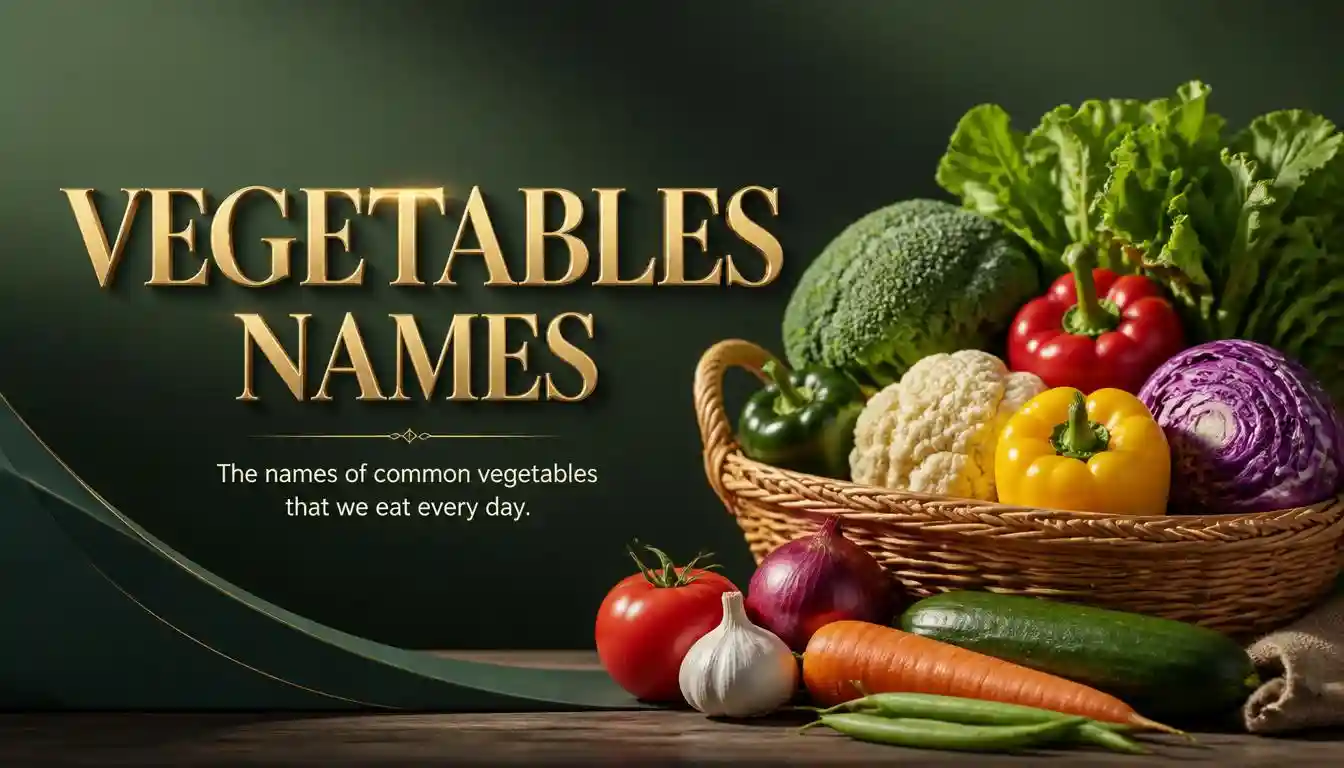
Learning vegetables names in English is a simple way to build everyday vocabulary. Vegetable words appear in recipes, grocery stores, restaurants, school lessons, cooking conversations, and English-learning activities. Knowing the names of vegetables also makes it easier to recognize foods when shopping or reading a menu.
In this guide, you’ll find 100+ vegetable names in English, an A–Z vegetable list, common vegetable names, pronunciation help, types of vegetables, green and leafy vegetables, and an easy section for kids and English learners.
Whether you are looking for vegetables names in English with pictures, vegetable names with pronunciation, or a simple vegetable vocabulary list, this guide brings the most useful information together in one place.
100+ Vegetables Names in English
| # | Vegetable Name | Simple Description |
| 1 | Potato | A starchy tuber used in fries, curries, soups, . |
| 2 | Tomato | A juicy red food commonly used in salads, sauces, and cooking. |
| 3 | Carrot | A crunchy root vegetable that is usually orange. |
| 4 | Onion | A bulb vegetable used to add flavor to many dishes. |
| 5 | Garlic | A small bulb made of cloves with a strong flavor. |
| 6 | Spinach | A soft leafy green commonly cooked |
| 7 | Cabbage | A leafy vegetable with tightly packed leaves. |
| 8 | Cauliflower | A white flower vegetable with a firm, |
| 9 | Broccoli | A green vegetable with a thick stem and small flower heads. |
| 10 | Cucumber | A crisp, watery vegetable often eaten raw in salads. |
| 11 | Eggplant | A smooth-skinned vegetable with soft flesh; |
| 12 | Peas | Small round green seeds found inside pods. |
| 13 | Green Beans | Long green pods commonly cooked as a side dish. |
| 14 | Bell Pepper | A crisp pepper available in colors such as green, red, yellow, and orange. |
| 15 | Chili Pepper | A pepper used to add heat and flavor to food. |
| 16 | Pumpkin | A large orange squash often used in soups, curries, |
| 17 | Radish | A small root vegetable with a crisp texture and peppery flavor. |
| 18 | Turnip | A round root vegetable with white flesh and a purple or white top. |
| 19 | Beetroot | A deep-red root vegetable with an earthy, sweet flavor. |
| 20 | Sweet Potato | A sweet-tasting root with orange, white, or purple flesh. |
| 21 | Lettuce | A crisp leafy vegetable commonly used in salads |
| 22 | Kale | A leafy green with firm, curly, or flat leaves. |
| 23 | Celery | A crisp vegetable with long edible stalks. |
| 24 | Asparagus | A green stem vegetable with long, tender spears. |
| 25 | Leek | A long vegetable related to onions, with a mild flavor. |
| 26 | Okra | A green pod vegetable often used in stews and curries. |
| 27 | Zucchini | A soft-skinned summer squash also known as courgette. |
| 28 | Corn | A grain-like food eaten fresh from the cob |
| 29 | Mushroom | A fungus commonly used as a vegetable in cooking. |
| 30 | Ginger | A knobby underground stem used as a spice and cooking ingredient. |
| 31 | Fennel | A bulb and stalk vegetable with a mild anise-like flavor. |
| 32 | Artichoke | A flower bud whose tender leaves and heart are eaten. |
| 33 | Arugula | A peppery leafy green often used in salads. |
| 34 | Brussels Sprouts | Small green vegetables resembling miniature cabbages. |
| 35 | Bok Choy | A leafy Asian vegetable with white stalks . |
| 36 | Swiss Chard | A leafy green with broad leaves and colorful stalks. |
| 37 | Collard Greens | Large, firm leafy greens often cooked slowly. |
| 38 | Mustard Greens | Peppery leafy greens used raw or cooked. |
| 39 | Turnip Greens | The edible green leaves of the turnip plant. |
| 40 | Spring Onion | A mild onion with a long green stalk. |
| 41 | Shallot | A small bulb related to onions and garlic. |
| 42 | Green Cabbage | A common cabbage with tightly packed green leaves. |
| 43 | Red Cabbage | A cabbage with purple-red leaves |
| 44 | Napa Cabbage | A pale green Chinese cabbage with elongated leaves. |
| 45 | Savoy Cabbage | A cabbage with wrinkled, loosely packed leaves. |
| 46 | Kohlrabi | A round vegetable with a swollen edible stem. |
| 47 | Parsnip | A pale root vegetable with a sweet, earthy taste. |
| 48 | Rutabaga | A round root vegetable also called swede. |
| 49 | Daikon | A long white radish common in Asian cuisines. |
| 50 | Taro | A starchy root that must be cooked before eating. |
| 51 | Lotus Root | A crisp root with distinctive holes running through it. |
| 52 | Cassava | A starchy root used in many tropical cuisines. |
| 53 | Yam | A group of starchy edible tubers. |
| 54 | Jerusalem Artichoke | A knobby edible tuber unrelated to the globe artichoke. |
| 55 | Bamboo Shoots | Young edible shoots of bamboo |
| 56 | Water Chestnut | A crisp aquatic plant part used in Asian cooking. |
| 57 | Bottle Gourd | A pale green gourd with a mild flavor. |
| 58 | Bitter Gourd | A ridged green gourd with a distinctly bitter taste. |
| 59 | Ridge Gourd | A long ridged gourd used in many cooked dishes. |
| 60 | Snake Gourd | A long, slender gourd with pale flesh. |
| 61 | Ivy Gourd | A small green striped gourd used in South Asian cooking. |
| 62 | Pointed Gourd | A small green gourd with white stripes. |
| 63 | Ash Gourd | A large pale gourd also called winter melon or wax gourd. |
| 64 | Chayote | A light-green pear-shaped squash. |
| 65 | Butternut Squash | A sweet orange-fleshed winter squash. |
| 66 | Acorn Squash | A small ridged squash with orange-yellow flesh. |
| 67 | Spaghetti Squash | A squash whose cooked flesh separates |
| 68 | Pattypan Squash | A small round squash with scalloped edges. |
| 69 | Edamame | Young green soybeans usually eaten after cooking. |
| 70 | Soybean | A legume used in foods such as tofu and soy products. |
| 71 | Chickpeas | Round legumes commonly used in salads, |
| 72 | Lentils | Small edible seeds used in soups, stews, and curries. |
| 73 | Broad Beans | Large flat beans also called fava beans. |
| 74 | Kidney Beans | Red or dark beans commonly used in soups and stews. |
| 75 | Black Beans | Small dark beans used in many dishes. |
| 76 | Snow Peas | Flat edible pods containing small peas. |
| 77 | Sugar Snap Peas | Crisp pods with sweet peas inside. |
| 78 | Moringa Pods | Long green pods from the moringa tree, often cooked in curries and soups. |
| 79 | Cluster Beans | Long green pods with a slightly firm texture. |
| 80 | Yardlong Beans | Very long green beans used in several Asian cuisines. |
| 81 | Amaranth Leaves | Edible leafy greens used in various cuisines. |
| 82 | Water Spinach | A leafy vegetable with hollow stems, popular in Asian cooking. |
| 83 | Malabar Spinach | A thick-leaved climbing green used like spinach. |
| 84 | Sorrel | A leafy green with a naturally sour flavor. |
| 85 | Endive | A leafy vegetable with a slightly bitter taste. |
| 86 | Dandelion Greens | Edible leaves with a pleasantly bitter flavor. |
| 87 | Garden Cress | Small peppery leaves often used in salads |
| 88 | Purslane | A succulent leafy green with a slightly sour flavor. |
| 89 | Coriander Leaves | Fresh aromatic leaves commonly used as a garnish and herb. |
| 90 | Mint | An aromatic herb used fresh in drinks, salads, and cooking. |
| 91 | Fenugreek Leaves | Fragrant leaves commonly used in South Asian dishes. |
| 92 | Curry Leaves | Aromatic leaves used to flavor many South Asian dishes. |
| 93 | Dill | A delicate herb with feathery |
| 94 | Parsley | A fresh green herb used for seasoning and garnish. |
| 95 | Watercress | A peppery leafy green that often grows near water. |
| 96 | Romanesco | A green vegetable related to broccoli and cauliflower. |
| 97 | Chinese Broccoli | A leafy vegetable with thick stems and small flower heads. |
| 98 | Tinda | A small round green squash commonly |
| 99 | Elephant Foot Yam | A large starchy underground tuber. |
| 100 | Drumstick | The long edible pod of the moringa tree. |
| 101 | Jute Leaves | Edible green leaves used in some soups and traditional dishes. |
| 102 | Fiddlehead Greens | Young curled shoots of certain edible ferns. |
| 103 | Wasabi | A pungent plant traditionally used |
| 104 | Tatsoi | A small leafy Asian green with spoon-shaped leaves. |
| 105 | Komatsuna | A leafy Japanese green related to mustard greens. |
Common Vegetable Names in English
If you are a beginner, you do not need to memorize 100 words at once. Start with the common vegetable names that appear most often in everyday conversations, recipes, and grocery shopping.
Some of the easiest vegetable names to learn are:
- Potato
- Tomato
- Carrot
- Onion
- Garlic
- Cucumber
- Spinach
- Cabbage
- Cauliflower
- Broccoli
- Peas
- Beans
- Corn
- Pumpkin
- Radish
- Turnip
- Eggplant
- Bell pepper
- Lettuce
- Sweet potato
For example:
- I bought some carrots.
- Please chop the onion.
- We need two potatoes for dinner.
- She added spinach to the soup.
- He likes grilled bell peppers.
Learning words through simple sentences can make vegetable vocabulary in English easier to remember than studying isolated words.
Vegetable Names A to Z
An A to Z vegetable names list is useful for students, teachers, vocabulary practice, and anyone searching for vegetables beginning with a particular letter.
| Letter | Vegetable Names |
| A | Artichoke, Asparagus, Arugula, Amaranth |
| B | Beetroot, Broccoli, Bok Choy, Brussels Sprouts, Beans |
| C | Carrot, Cabbage, Cauliflower, Celery, Cucumber, Corn |
| D | Daikon, Dandelion Greens, Drumstick |
| E | Eggplant, Endive, Edamame |
| F | Fennel, French Beans, Field Peas |
| G | Garlic, Green Beans, Green Peas |
| H | Horseradish |
| I | Iceberg Lettuce, Ivy Gourd |
| J | Jerusalem Artichoke |
| K | Kale, Kohlrabi, Komatsuna |
| L | Lettuce, Leek, Lotus Root |
| M | Mushroom, Mustard Greens, Malabar Spinach, Moringa |
| N | Napa Cabbage, New Zealand Spinach |
| O | Onion, Okra |
| P | Potato, Pumpkin, Peas, Parsnip |
| Q | Queen Anne’s Lace Root |
| R | Radish, Rutabaga, Red Cabbage, Rocket |
| S | Spinach, Shallot, Sweet Potato, Swiss Chard |
| T | Tomato, Turnip, Taro, Tatsoi |
| U | Ulluco |
| V | Vegetable Marrow |
| W | Watercress, Water Chestnut, Water Spinach |
| X | Xanthosoma |
| Y | Yam, Yardlong Bean |
| Z | Zucchini |
Some letters have relatively few familiar vegetable names in everyday English. That is why an A–Z list should not force obscure words simply to make every letter look equally full.
Vegetable Names With Pictures
Pictures can make vegetable names with pictures much easier to learn, especially for children and beginners. Visual learning connects the written word with the actual food.
For example:
🥔 Potato — brown skin and pale flesh; commonly baked, boiled, mashed, or fried.
🥕 Carrot — usually orange, crunchy, and tapered; often eaten raw or cooked.
🍅 Tomato — usually red when ripe; widely used in salads, sauces, and cooked dishes.
🥬 Spinach — soft green leaves used fresh or cooked.
🥦 Broccoli — green flower heads attached to firm stalks.
🥒 Cucumber — green, crisp, and watery; often eaten raw.
🧅 Onion — layered bulb with a strong aroma and flavor.
🍆 Eggplant — commonly purple with soft flesh when cooked.
🌽 Corn — yellow or other-colored kernels arranged on a cob.
🎃 Pumpkin — large round squash with firm flesh and seeds inside.
For a website article, clear photographs or illustrations placed beside the names can make this section much more useful than repeating the same text list.
Types of Vegetables
There are several useful ways to group vegetables. One simple approach is to group them according to the part of the plant that is eaten. Educational vegetable resources commonly use categories such as leafy, root, stem, flower, bulb, and podded vegetables.
Root Vegetables
Root vegetables grow underground or have an edible underground root.
Examples include:
- Carrot
- Radish
- Beetroot
- Turnip
- Parsnip
- Daikon
- Sweet potato
- Cassava
Leafy Vegetables
Leafy vegetables are mainly eaten for their leaves.
Examples include:
- Spinach
- Kale
- Lettuce
- Cabbage
- Swiss chard
- Collard greens
- Mustard greens
- Bok choy
- Water spinach
Stem Vegetables
These vegetables are valued mainly for their edible stems or stalks.
Examples include:
- Celery
- Asparagus
- Bamboo shoots
- Kohlrabi
Flower Vegetables
The flower or immature flower structure is eaten.
Examples include:
- Broccoli
- Cauliflower
- Artichoke
Bulb Vegetables
Bulbs are underground storage structures.
Examples include:
- Onion
- Garlic
- Shallot
- Leek
Pod and Seed Vegetables
Many legumes are eaten as pods or for their seeds.
Examples include:
- Peas
- Green beans
- Snow peas
- Sugar snap peas
- Broad beans
- Yardlong beans
- Edamame
Gourd and Squash Vegetables
This group includes many soft or hard-skinned gourds and squashes.
Examples include:
- Pumpkin
- Zucchini
- Bottle gourd
- Bitter gourd
- Ridge gourd
- Snake gourd
- Ash gourd
- Chayote
- Butternut squash
Green Vegetable Names
If you are searching for green vegetable names, there are many familiar choices.
Here are some common examples:
- Spinach
- Broccoli
- Cabbage
- Kale
- Lettuce
- Green beans
- Green peas
- Cucumber
- Zucchini
- Asparagus
- Celery
- Okra
- Bok choy
- Swiss chard
- Watercress
- Green bell pepper
- Brussels sprouts
- Mustard greens
- Water spinach
- Spring onion
Green vegetables can vary greatly in taste and texture. Some are crisp when raw, while others become soft after cooking.
Leafy Vegetable Names
Leafy vegetables are especially useful vocabulary words because they appear frequently in food, cooking, and health-related conversations.
Common leafy vegetable names include:
- Spinach
- Kale
- Lettuce
- Cabbage
- Bok choy
- Swiss chard
- Collard greens
- Mustard greens
- Arugula
- Watercress
- Endive
- Amaranth leaves
- Malabar spinach
- Water spinach
- Sorrel
- Dandelion greens
Try using these words in simple sentences:
I added spinach to the soup.
She made a salad with lettuce and arugula.
Bok choy is often used in stir-fries.
Vegetable Names With Pronunciation
Pronunciation can be difficult for English learners because spelling does not always show exactly how a word sounds.
Here are some useful examples:
| Vegetable | Simple Pronunciation Guide |
| Carrot | KARR-ut |
| Cabbage | KAB-ij |
| Cauliflower | KAW-li-flow-er |
| Broccoli | BROK-uh-lee |
| Cucumber | KYOO-kum-ber |
| Eggplant | EGG-plant |
| Spinach | SPIN-ich |
| Asparagus | uh-SPAIR-uh-gus |
| Zucchini | zoo-KEE-nee |
| Lettuce | LET-is |
| Radish | RAD-ish |
| Potato | puh-TAY-toh |
| Tomato | tuh-MAH-toh |
| Onion | UN-yun |
| Garlic | GAR-lik |
| Celery | SELL-uh-ree |
| Artichoke | AR-ti-choke |
| Fennel | FEN-ul |
| Parsley | PARS-lee |
| Beetroot | BEET-root |
Pronunciation guides are particularly helpful for vegetable names for beginners and English learners. A learner can first read the word, then say it aloud, and finally use it in a sentence.
Vegetable Names for Kids and English Learners
Learning vegetable names for kids does not have to feel like memorizing a dictionary.
Start with familiar words:
Potato, tomato, carrot, onion, peas, beans, spinach, cabbage, cucumber, corn, broccoli, pumpkin, radish, and lettuce.
Then use pictures, flashcards, games, matching activities, and short sentences.
For example:
Carrot → “This is a carrot.”
Potato → “I like potatoes.”
Tomato → “The tomato is red.”
Cucumber → “The cucumber is green.”
Broccoli → “I can see broccoli.”
Pictures are especially useful because children can connect the written English word with the actual vegetable. Educational resources also commonly use pictures and simple examples to teach vegetable vocabulary to children.
How to Learn Vegetable Names in English
If you are learning vegetable vocabulary in English, use a simple routine instead of trying to memorize the whole list in one day.
1. Start With 10 Common Words
Learn words such as potato, tomato, carrot, onion, spinach, cabbage, cucumber, peas, corn, and broccoli.
2. Match Words With Pictures
Look at a vegetable and say its English name. Then cover the name and try to remember it.
3. Practice Pronunciation
Say each word slowly and then at normal speaking speed.
4. Use Short Sentences
Instead of only memorizing “carrot,” say:
“I bought three carrots.”
5. Group Similar Words
Study root vegetables together, leafy vegetables together, and gourds together.
6. Practice While Shopping or Cooking
Real-life practice is one of the easiest ways to remember vocabulary. Read labels, recipes, shopping lists, and menus.
Learning vegetable vocabulary can also help with everyday English used for grocery shopping, recipes, restaurants, and conversations about food.
What Makes a Vegetable Name Easy to Remember?
A vegetable name becomes easier to remember when you connect it with three things:
Word + Picture + Sentence
For example:
Broccoli → 🥦 → “I cooked broccoli for dinner.”
This method helps learners remember spelling, meaning, pronunciation, and usage at the same time.
You can also connect vegetables with colors:
- Orange → carrot
- Green → spinach
- Purple → eggplant
- Red → tomato
- White → cauliflower
- Yellow → corn
This creates simple mental associations that can make vocabulary practice more enjoyable.
Frequently Asked Questions About Vegetable Names
What are 10 common vegetable names?
Ten common vegetable names are potato, tomato, carrot, onion, spinach, cabbage, cauliflower, broccoli, cucumber, and peas.
What are 20 vegetable names in English?
Twenty examples are potato, tomato, carrot, onion, garlic, spinach, cabbage, cauliflower, broccoli, cucumber, eggplant, peas, green beans, bell pepper, pumpkin, radish, turnip, beetroot, sweet potato, and lettuce.
What are 100 vegetable names?
There are many vegetables around the world, including common vegetables and regional varieties. The list above provides more than 100 vegetable names in English, including potatoes, carrots, onions, spinach, broccoli, gourds, leafy greens, beans, roots, shoots, and squash.
What are the vegetable names from A to Z?
Examples include Artichoke for A, Broccoli for B, Carrot for C, Daikon for D, Eggplant for E, Fennel for F, Garlic for G, Kale for K, Lettuce for L, Mushroom for M, Onion for O, Potato for P, Radish for R, Spinach for S, Tomato for T, Watercress for W, Yam for Y, and Zucchini for Z.
What are some green vegetable names?
Common green vegetables include spinach, broccoli, cabbage, kale, lettuce, green beans, peas, cucumber, zucchini, asparagus, celery, okra, and green bell peppers.
What are leafy vegetable names?
Common leafy vegetables include spinach, kale, lettuce, cabbage, bok choy, Swiss chard, collard greens, mustard greens, arugula, watercress, and amaranth leaves.
What are root vegetable names?
Common root vegetables include carrot, radish, beetroot, turnip, parsnip, daikon, sweet potato, and cassava.
What are some vegetable names for kids?
Easy vegetable names for kids include carrot, potato, tomato, onion, peas, beans, corn, cucumber, spinach, cabbage, broccoli, pumpkin, and lettuce.
How can children learn vegetable names in English?
Children can learn vegetable names by using pictures, flashcards, simple sentences, matching games, coloring activities, pronunciation practice, and real vegetables. Starting with common words makes the learning process easier.
How do you pronounce common vegetable names?
Some common pronunciations are carrot — KARR-ut, potato — puh-TAY-toh, tomato — tuh-MAH-toh, broccoli — BROK-uh-lee, cucumber — KYOO-kum-ber, and spinach — SPIN-ich.
What are the different types of vegetables?
Vegetables can be grouped in several ways, including root, leafy, stem, bulb, flower, pod, seed, gourd, and squash vegetables. These categories help organize vegetable vocabulary and make the names easier to learn.
Final Thoughts
Learning vegetables names in English is useful for children, students, English learners, home cooks, and anyone who wants stronger everyday vocabulary. Start with common vegetables, learn their pronunciation, connect each word with a picture, and practice using the words in short sentences.
Once you know the basic names, expand your vocabulary with vegetable names A to Z, leafy vegetables, root vegetables, green vegetables, gourds, beans, and other less common varieties.
The easiest approach is simple: see the vegetable, say its name, spell the word, and use it in a sentence. With regular practice, even a list of 100+ vegetable names can become easy to remember and use confidently.

I’m Shahid Imran, the creator of Reachora Media, a website dedicated to names, their meanings, origins, pronunciations, and interesting name-related information. Explore my website to discover meaningful and unique names with helpful, easy-to-understand details: Reachora Media